Telling the Stories That Matter: Meet Prisca Mbewe
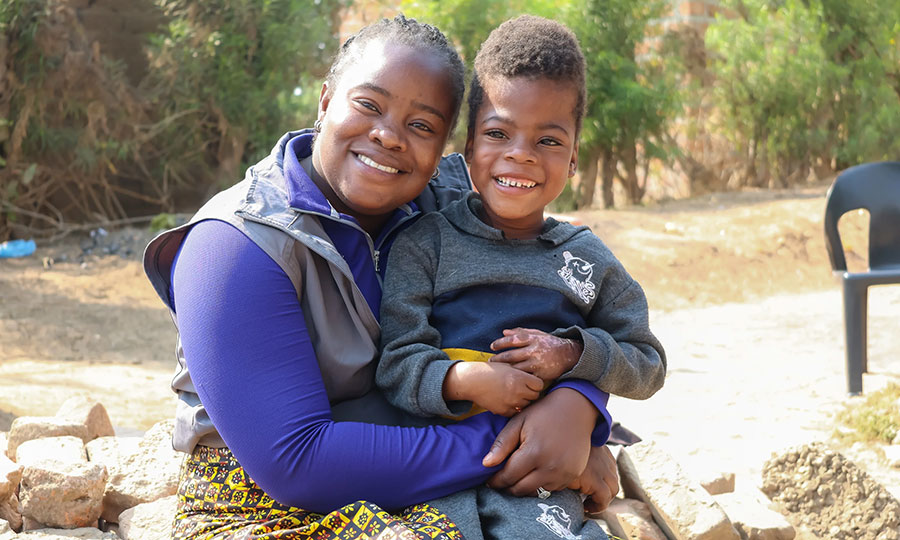
Communications Officer Prisca Mbewe reunites with little Cathy, a child enrolled in Access to Health Zambia’s Kusamala Project. When Prisca first met her three years ago, Cathy couldn’t yet walk or talk due to significant developmental challenges. Today, that’s no longer the case—Cathy can walk, talk, and interact with confidence. (Brown & Chi for Access to Health Zambia).
CMMB takes great pride in reporting on the impact made possible by our donors and partners. Few things are more meaningful than telling the story of a life changed with dignity, respect, and commitment. Prisca Mbewe is responsible for telling these stories on behalf of Access to Health Zambia (A2HealthZ), a member of the CMMB global community. Within the communities reached by A2HealthZ, she is both a friend and a witness, raising the voice of mothers, fathers, and community leaders who share their experience with us. In this special Q&A, get to know Prisca as she reflects on her role as a storyteller and what it means to capture moments of change in mission-driven work.
1) What drew you to communications in the public health space?
From a young age, I knew I wanted to tell stories. My initial dream was to become a broadcast journalist. I was fascinated by television—by the power of the camera and the newsroom to shape conversations and inform the public. I imagined myself reporting from the field, bringing important issues to light.
As much as I loved journalism, I began to feel that I wanted to do more than just report stories. I wanted to be part of the change behind the stories.
When I was given an opportunity to work with a non-governmental organization, everything shifted for me. For the first time, I was not just documenting impact, I was witnessing it from within. I was interacting directly with communities, listening to mothers share their struggles, seeing children access services they had previously gone without, and understanding the deep connection between communication and transformation.
That experience completely changed my perspective.
I realized that communications in the public health space is not just about visibility. It is about advocacy, behavior change, accountability, and dignity. It is about ensuring that a mother in a rural village feels seen. It is about translating technical health interventions into human stories that resonate with donors, partners, and policymakers. It is about bridging the gap between communities and the global stage.
My work in public health communications allows me to combine storytelling with purpose. Every success story and every photo is an opportunity to influence action and mobilize support for those who need it most.
I have never looked back since.
2) In your role as a storyteller, how have your experiences redefined the way you understand change in the communities you serve?
I have been with CMMB/Access to Health Zambia for over four years now, and it has been one of the most defining chapters of my professional journey.
Working with Access to Health Zambia has reshaped how I view impact. It is not always loud or immediate. Sometimes it is gradual, like a child learning to walk, a mother gaining confidence, or a rural health post becoming fully functional. And being present to capture those moments is something I do not take lightly.
3) What is one thing about Access to Health Zambia that you want everyone to know?
One thing I want everyone to know about Access to Health Zambia is that we do not just implement projects, we walk alongside communities.
Our work is not about short-term interventions or temporary visibility. It is about building systems that last, strengthening local capacity, and restoring dignity in the most practical ways. Whether we are constructing mothers’ shelters in rural health facilities, training community health workers or improving access to clean water, our approach is rooted in sustainability and community ownership.
The communities we work with are our biggest partners. They are co-creators of the solutions we implement. We engage traditional leaders, neighborhood health committees, mothers, fathers, caregivers, and frontline health workers because sustainable change cannot happen without local ownership.
We partner with community leaders to understand the real needs on the ground. We empower families with knowledge, practical skills, and tools that allow them to take charge of their own health and well-being. We build local capacity by training community health workers and strengthening health systems, so that impact continues long after a project cycle ends.
Access to Health Zambia believes that access to health is not a privilege; it is a right. Every mother deserves a safe delivery. Every child deserves the chance to grow, learn, and thrive. Every community deserves access to quality healthcare close to home.
What makes our work even more special is the human connection. Behind every report, every statistic, and every donor update is a real family whose life has changed. That is what drives us, and that is what I wish everyone knew.