Strengthening Health Systems Through Strategic Partnerships
A New Chapter for CMMB’s Volunteer Program
By Marcia Grand Ortega, Strategic Partnerships and Global Volunteer Initiatives
Volunteerism has been central to CMMB’s work since its inception more than a century ago. Over the past decade alone, CMMB’s Volunteer Program has connected hundreds of skilled medical and public health professionals with communities across Eswatini, Ghana, Kenya, South Sudan, Sudan, Zambia, Haiti, and Peru. The contributions of volunteers have helped improve the quality of care delivered by frontline health workers in some of the world’s most underserved settings.
But the challenges facing the communities served by CMMB have changed—and so have their needs. At the same time, the development sector is also changing, calling for new types of partnerships.
Reimagining CMMB’s Volunteer Program
The global health landscape is shifting rapidly as aid funding contracts. The burden of disease in the countries we serve continues to evolve beyond maternal and child health towards noncommunicable diseases, including mental health, and emerging infectious threats. Conversations across the sector about centering local leadership are shaping how organizations like CMMB approach partnerships, knowledge sharing, and sustainable impact.
Amid all these changes, CMMB began engaging volunteers to meet new demands—not only to address clinical service gaps. Global teams requested support in areas such as research writing, strategic communications, IT leadership, and AI and digital health. These non-clinical volunteer needs were matched with skilled professionals who committed to defined projects managed remotely or in hybrid formats. Like clinical volunteers, success relied on collaboration with local teams. The positive feedback we received prompted us to reevaluate our current strategy and helped inform our new one.
Building Strategic Partnerships and Global Volunteer Initiatives
CMMB’s Volunteer Program initiated a formal review process in early 2024. We engaged with country leaders, program managers, and department leads across all countries where we work. We asked what was working, what was missing, and what kind of partnerships could most effectively contribute to stronger health systems. What emerged was a fundamental rethinking of what volunteer engagements could be and how they come about.
Rather than focusing solely on clinical and public health volunteer placements, Strategic Partnerships and Global Volunteer Initiatives support capacity strengthening and partnership building across the global organization—connecting CMMB’s teams with academic, health, and corporate partners, as well as skilled individuals for demand-driven collaboration. This change is a recognition that strengthening health systems today requires more than clinical hands; it requires the full range of expertise that keeps an organization like CMMB connected and adaptive.
Three structured needs assessment cycles per year ensure that sourcing remains aligned with what global teams actually need. Placements span clinical education, operational research, technical advisory, content creation, and more, in field-based, hybrid, and remote formats.
The New Approach in Practice
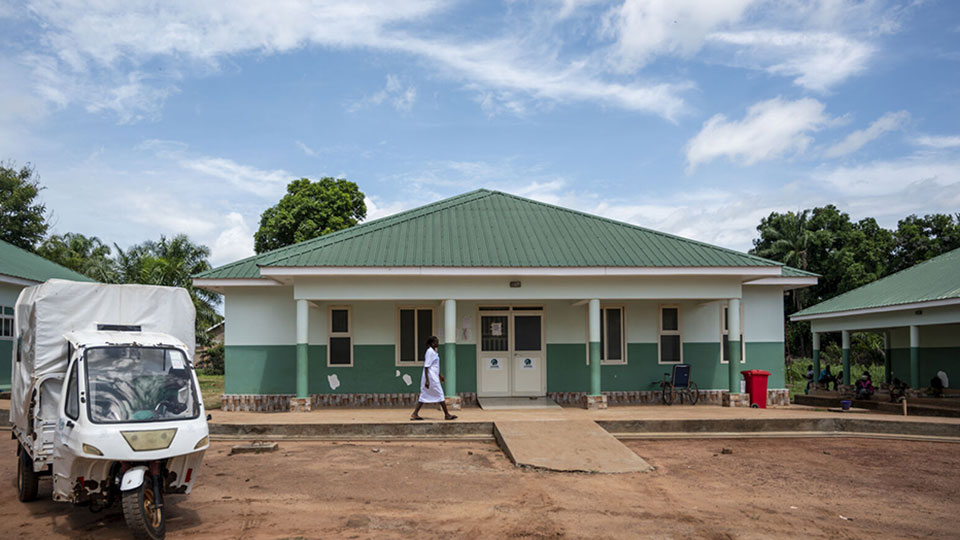
St. Theresa Mission Hospital in Nzara, South Sudan manages its own Infection Prevention and Control Committee, which collaborates with a team of global CMMB volunteers.
The program’s evolution is perhaps best illustrated by the projects already underway. At St. Theresa Mission Hospital, a 180-bed rural facility serving more than 300,000 people in a vast rural region in Western Equatoria State, South Sudan, a team of remote volunteers helped form and worked alongside the hospital’s local Infection Prevention and Control Committee to develop formal protocols for hand hygiene, sterilization of surgical instruments, and disease surveillance.
Everything was adapted to the real constraints of the setting, designed to be maintained locally to improve patient and staff safety—and the results have been noticeable. The WHO WASH and South Sudan’s Ministry of Health recognized St. Theresa Hospital as the cleanest hospital with the best waste management system in South Sudan.
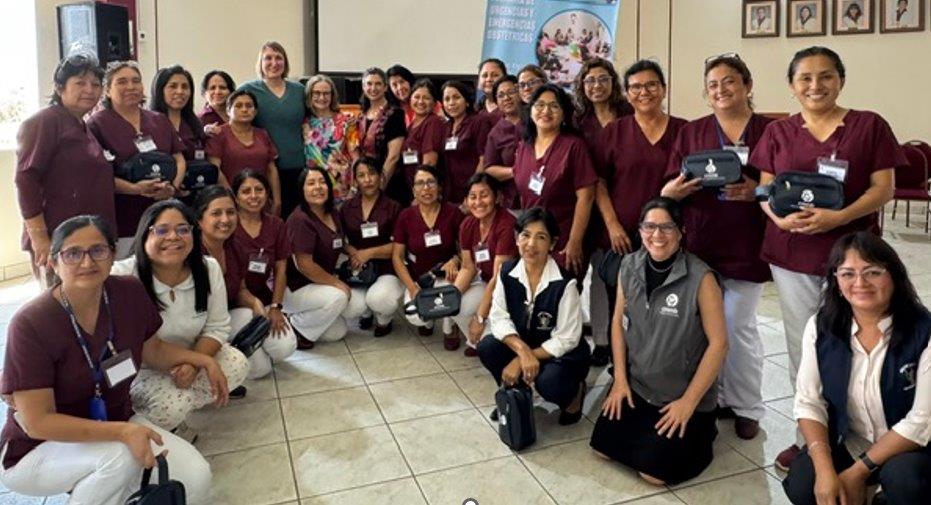
Providence Health staff with CMMB Peru during an in-person training in obstetric emergencies.
In Peru, a partnership with Providence Health brought OB/GYN specialists to train local healthcare workers on obstetric emergencies. Phase one was delivered in 2025, certifying 56 healthcare professionals in primary care of obstetric emergencies. Phase two launched virtually this year, reaching approximately 500 healthcare workers across the region and certifying 60 healthcare workers during a two-day in-person training.
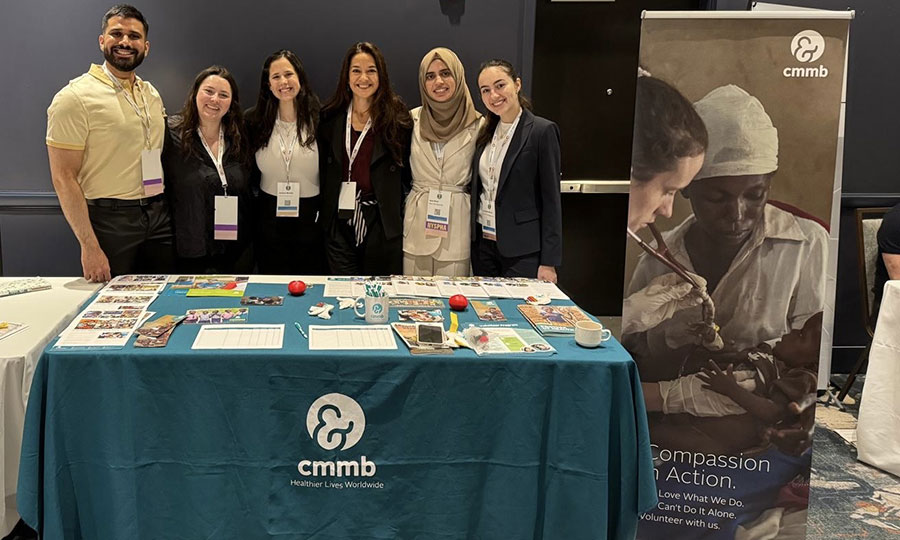
NYU students present their work at a Public Health Conference.
Through a growing network of university partnerships, including New York University, Pace University, Columbia, Georgetown, Vanderbilt, Boston University and others, graduate students are contributing to research, program evaluation, grant writing, and communications support in structured individual and group projects that benefit both CMMB teams and students’ professional development.
Since adopting this approach, the program has engaged more than 100 volunteers this year—already surpassing its annual target—contributing over $1.2 million in value of service to CMMB’s country programs.
What’s Next
We are continuing to deepen academic and corporate partnerships that keep the program accountable to the people it is designed to serve.
We will continue to share updates, case studies, and stories as the program grows. If you are a health professional, researcher, university, or organization interested in contributing your expertise to this work or engaging your staff in global health efforts, we would love to hear from you. Learn more about volunteer and partnership opportunities by connecting with our team here.